

In brief: In 2020, Fibrobec invested more than $2 million in resin transfer molding to make its fiberglass doors. Production went from 18 doors a day to 18 doors in under two hours, the doors have no defects, and VOC emissions have been eliminated.
It’s no secret that productivity is the key for every business. When you manage to be productive, overcome labour shortages and reduce your environmental footprint at the same time, that’s a real success!
That’s exactly what Fibrobec has achieved! It’s no accident that this Beloeil SME is now considered the largest fiberglass truck cap manufacturer in Canada.
In 2020, Fibrobec transformed its door manufacturing department by acquiring an injection pump for resin transfer molding, some thirty mold and counter-mold sets and an industrial vacuum system, an investment of more than $2 million.
Resin transfer molding is a semi-automated process that takes place between a mold and a counter-mold, allowing a cavity to be filled perfectly. Thanks to this technology, all the doors on Fibrobec service bodies are uniform and more rigid.
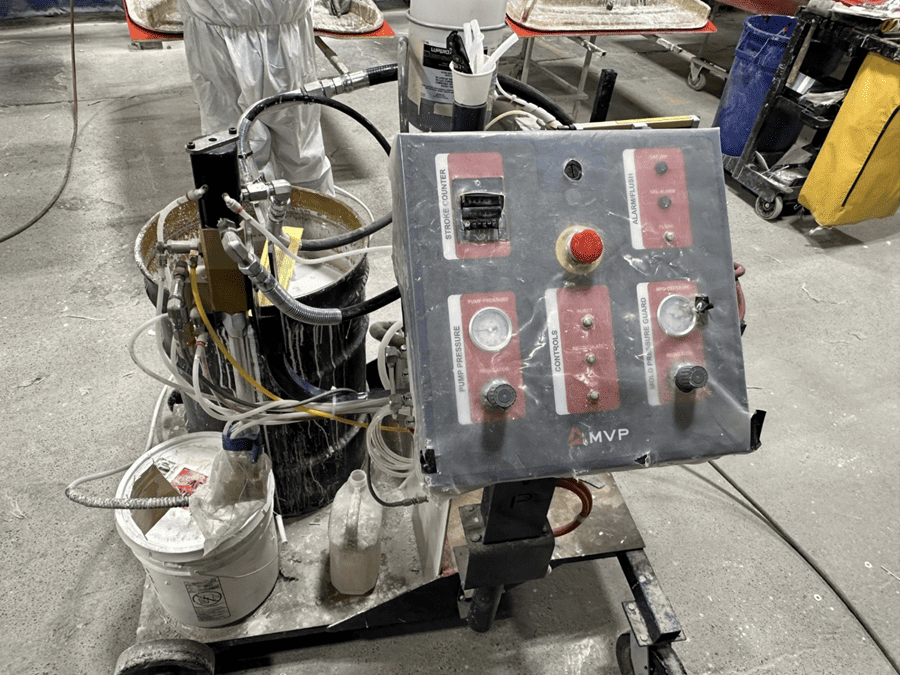
An investment that would revolutionize the way fiberglass doors are made. For example, Fibrobec could initially make 18 doors a day. It can now produce 18 in under two hours: “Thanks to this technology, we have quadrupled our production! Not only have we increased our production capacity, our doors now have no defects at all, which means we can eliminate all repairs,” reports Christian Lauzier, Vice President of Operations at Fibrobec.
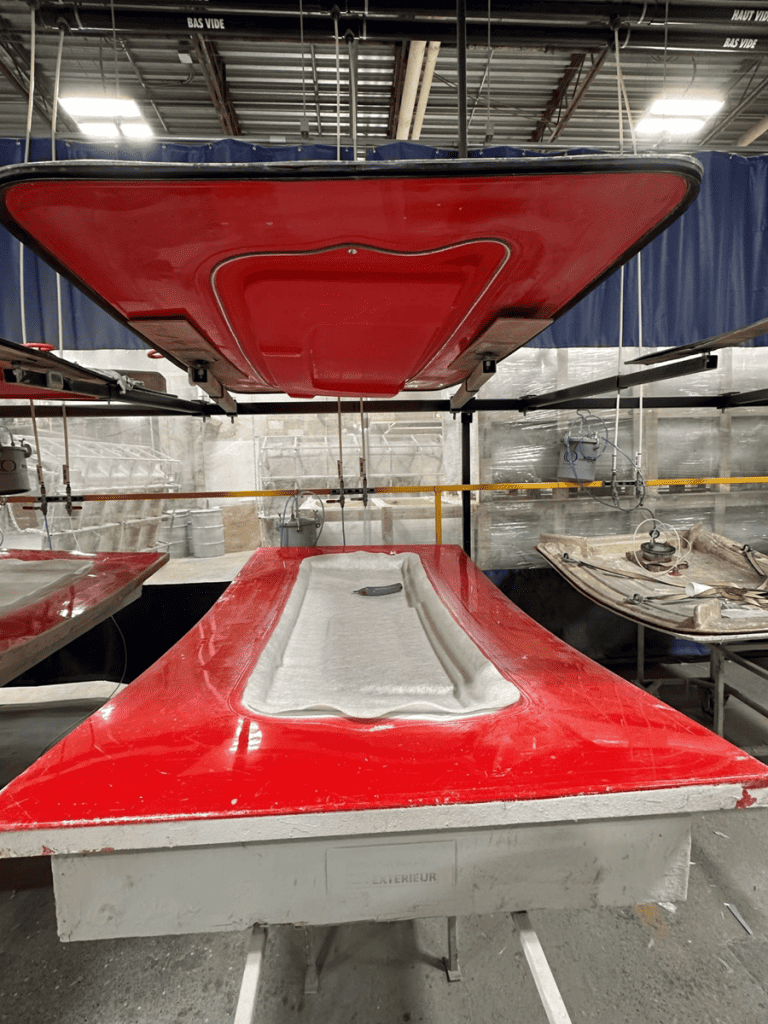
With the labour shortage, this kind of technology is very welcome! It reduces training time, since the process is easy to operate and requires only minimal dexterity, unlike the old method where laminating fiberglass doors by hand took a lot of patience and experience.

Injecting resin with this pump also eliminates volatile organic compound (VOC) emissions. That was another important factor for Fibrobec in justifying the investment: “With the old open-mold laminating method, a large volume of styrene molecules evaporated and created an odour. Today, with resin transfer molding, the free styrene is almost entirely used up in the polymerization reaction, and the little that evaporates is captured directly under vacuum, so our emissions are at zero,” adds Christian Lauzier.
Productivity. Growth. Consistency. Better cost control and environmental responsibility! Everyone wins!
Frequently asked questions
What is resin transfer molding?
It is a semi-automated process that takes place between a mold and a counter-mold, filling the cavity perfectly so the doors are uniform and more rigid.
How did it change door production?
Fibrobec used to make 18 doors a day; it now produces 18 in under two hours. Production has quadrupled and the doors have no defects.
Is the process better for the environment?
Yes. Injecting resin eliminates volatile organic compound (VOC) emissions: the free styrene is almost entirely used up and the little that evaporates is captured under vacuum.
